
Advances in refractive surgery now make it possible to correct vision problems with techniques that are increasingly precise and minimally invasive. Among the latest innovations is the KLEX (Kerato Lenticule Extraction), an advanced procedure that corrects myopia and astigmatism without creating a corneal flap.
This technology represents the natural evolution of laser vision correction and offers a modern alternative to LASIK for selected patients.
What Is KLEX?
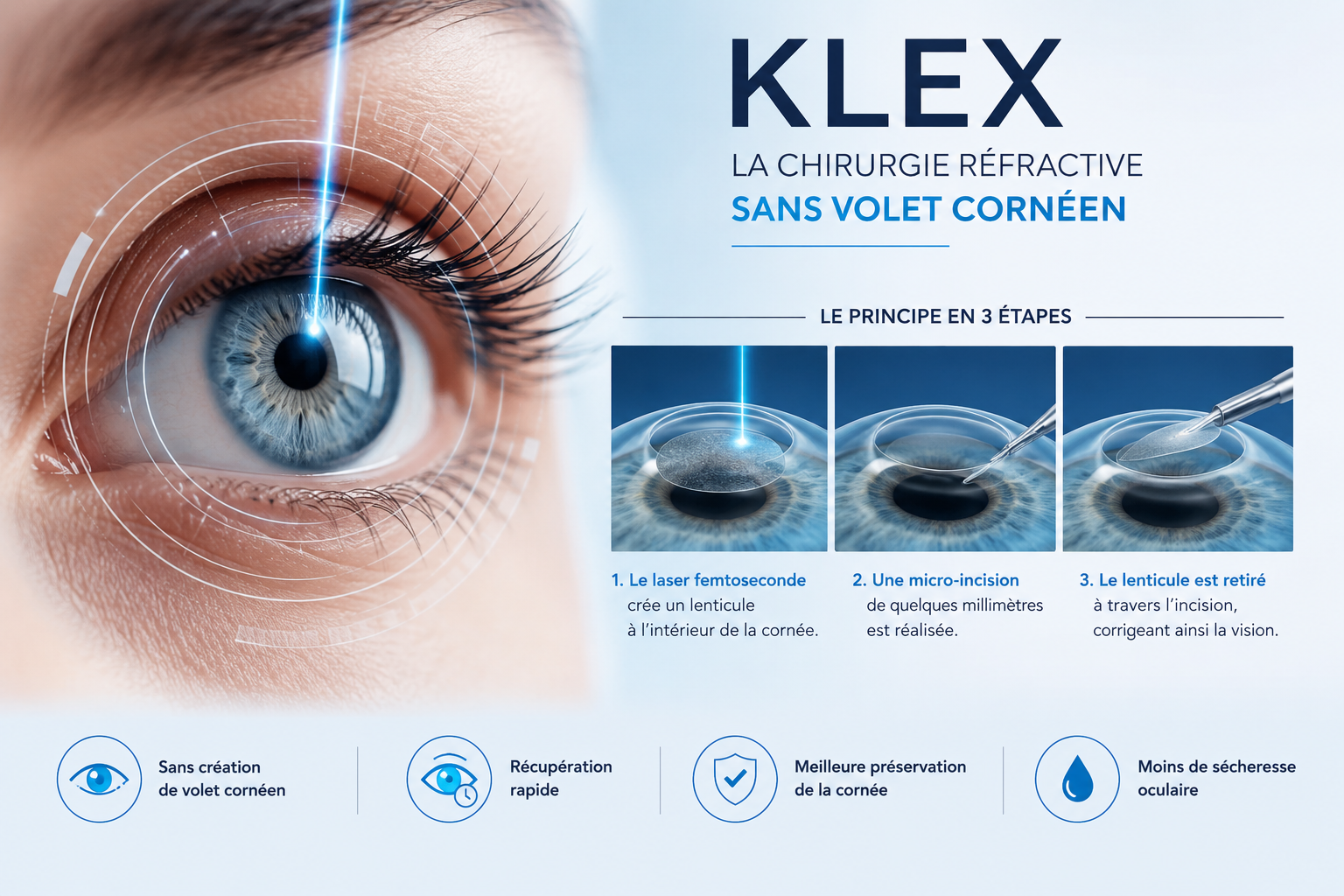
KLEX is a refractive surgery technique that uses only a femtosecond laser. The laser creates an ultra-thin lenticule of tissue within the cornea, precisely matching the patient's required vision correction.
The lenticule is then removed through a micro-incision measuring only a few millimeters, reshaping the cornea and correcting the refractive error.
Unlike LASIK, no corneal flap needs to be created.
The Different Technologies Available
Several manufacturers now offer their own lenticule extraction technology:
- SMILE Pro® by Carl Zeiss Meditec;
- SILK® by Johnson & Johnson Vision.
- SILK® de Johnson & Johnson Vision.
Although each platform has its own technological features, they all rely on the same principle: removing a corneal lenticule with micrometer-level precision to correct vision.
Key Benefits
A Minimally Invasive Procedure
The very small incision helps preserve more of the cornea’s natural structure. The procedure is performed without creating a corneal flap, which is one of the main differences compared with LASIK.
Fast Recovery
Most patients regain functional vision within the first 24 to 48 hours. Visual quality then continues to improve gradually over the following weeks.
Better Preservation of Corneal Biomechanics
By preserving more of the cornea’s superficial fibers, KLEX better maintains the eye’s natural corneal architecture.
A Reduced Risk of Dry Eye
Because fewer corneal nerve fibers are disrupted, some patients experience fewer symptoms of dry eye after the procedure compared with techniques that require the creation of a corneal flap.
Excellent Long-Term Stability
The results are long-lasting when the patient's prescription is stable before surgery. Clinical studies have demonstrated a high level of accuracy in the correction of myopia and astigmatism.
Who Is KLEX Suitable For?
KLEX is primarily suitable for patients with:
- mild to high myopia;
- astigmatism;
- a combination of myopia and astigmatism.
However, the choice of this technique depends on several factors, including:
- corneal thickness;
- the shape of the cornea;
- the stability of the vision prescription;
- the condition of the ocular surface;
- the patient's age;
- the patient's professional or sporting activities.
A comprehensive preoperative assessment is essential to determine whether this technique is the most appropriate option for the patient.
KLEX or LASIK?
Both techniques provide excellent results and, in most cases, significantly reduce dependence on glasses or contact lenses.
LASIK remains the global gold standard, backed by decades of clinical experience and an exceptionally fast visual recovery.
KLEX, on the other hand, offers several advantages thanks to its minimally invasive approach, including the absence of a corneal flap and better preservation of corneal tissue.
The choice between these different techniques is therefore not based on a general preference, but on each patient's individual characteristics.
A Personalized Decision
There is no universal solution in refractive surgery. Every eye has its own unique anatomical characteristics, and every patient has different visual needs.
During the eligibility assessment, the surgeon performs a comprehensive series of examinations to evaluate the cornea, visual quality, the stability of the prescription, and the patient's expectations. Based on these findings, the most appropriate procedure is recommended, whether KLEX, LASIK, TransPRK, or another vision correction technique.
In Conclusion
KLEX represents a major advancement in modern refractive surgery. Using a minimally invasive procedure performed entirely with a femtosecond laser, it effectively corrects certain refractive errors while preserving more of the cornea’s natural structure.
As with any refractive surgery procedure, the success of the treatment depends primarily on careful patient selection and a comprehensive preoperative assessment to determine the most appropriate technique for each individual case.